Wilhelm Eduard Weber

Article
by: J J O'Connor and E F Robertson (University of St. Andrews, Scotland)
Wilhelm
Eduard Weber
Born: 24 Oct 1804 in Wittenberg,
Saxony (now Germany)
Died: 23 June 1891 in Göttingen,
Germany
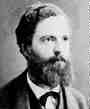
Wilhelm Weber entered the University of Halle in 1822 and wrote his
doctoral dissertation in 1826. After that he taught at Halle.
In 1831 Weber
was appointed to the chair of physics at Göttingen and there followed 6 years
of close friendship and collaboration with Gauss. Weber developed sensitive magnetometers
and other magnetic instruments during this time.
When Victoria became Queen
of Britain in 1837 her uncle became ruler of Hanover and revoked the liberal constitution.
Weber was one of 7 professors at Göttingen to sign a protest and all were dismissed.
He remained at Göttingen without a position until 1843 when he became professor
of physics at Leipzig.
In 1848 he returned to his old position in Göttingen
and, in 1855, he and Dirichlet became temporary directors of the astronomical
observatory there. His work on the ratio between the electrodynamic and electrostatic
units of charge in 1855 proved extremely important and was crucial to Maxwell
in his electromagnetic theory of light. Weber found the ratio was 3.1074  108
m/sec but failed to take any notice of the fact that this was close to the speed
of light.
108
m/sec but failed to take any notice of the fact that this was close to the speed
of light.
Weber's later years at Göttingen were devoted to work in electrodynamics
and the electrical structure of matter. He was described by Thomas Hirst in the
following way:
He speaks and stutters on unceasingly, one has nothing to
do but listen. Sometimes he laughs for no earthly reason, and one feels sorry
at being not able to join him.
 About this site