Energy Sources Crossword
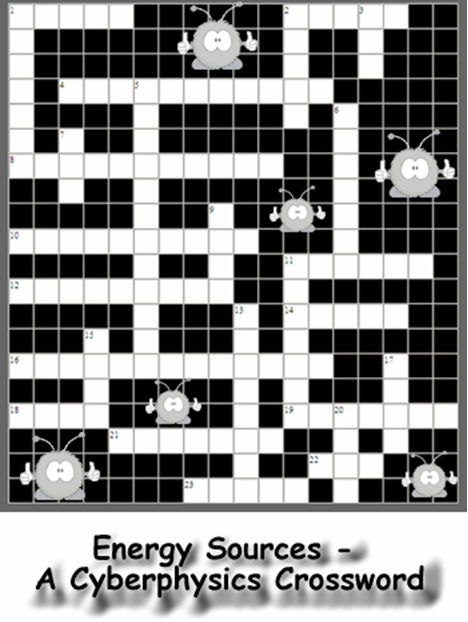
Clues Across:
| 1 |
A form of energy that comes from the gravitational pull of the moon on the oceans. |
| 2 |
A metal structure that carries electrical cables from the power station to the town. |
| 4 |
This changes the voltage of the electrical power so that transmission of energy is as efficient as possible. |
| 8 |
The most versatile form of energy - the form we make use of in most of our modern appliances. It is the output energy form from our power stations.
|
| 10 |
Energy of the Earth - the Earth's interior is hot because of the radioactive decay of isotopes within the interior. |
| 11 |
An ancient living creature changes into this type of rock form after millions of years. |
| 12 |
These energy forms are being constantly replenished by nature. We will therefore never run out of them. |
| 14 |
This is produced when water is heated. The pressure of this is then used to turn turbines in power stations to make electricity. |
| 16 |
Electricity made from moving water. |
| 18 |
Moving air - a fantastic natural source of renewable energy. |
| 19 |
A power source that uses the energy released when the nucleus of an atom is split.
|
| 21 |
The gas that is formed within the Earth from fossilised remains. |
| 22 |
The gaseous fossil fuel. |
| 23 |
Energy from the sun |
Clues Down:
| 1 |
The device that is turned within a power station to produce electrical energy from kinetic energy |
| 2 |
Energy produced in a given time. |
| 3 |
The liquid fossil fuel |
| 5 |
A form of natural energy that is not replenished within a short time scale and so we will run out of it.
|
| 6 |
All once living matter that can be used as a fuel. |
| 7 |
Shortened name for hydroelectric power |
| 9 |
When the wind blows on the water the energy from the wind is stored in the water as this form. |
| 11 |
The technical name for the splitting of an atom's nucleus. |
| 13 |
13 down and 15 down is the name of the system that transports energy across the country. |
| 15 |
13 down and 15 down is the name of the system that transports energy across the country.
|
| 17 |
The name of something that stores energy in a chemical form which can be transformed into another form when it is burned. |
| 20 |
The solid fossil fuel. |
 Link to crossword solution
 Link to printable worksheet
 About this site