 About this site
 |
Moments, Torque and Levers Moments in physics have nothing to do with time!
The moment of a force is the turning effect that it has. It is measured in newton metres (Nm).
Torque is another term for ' moment', or moment of force in physics - it is the tendency of a force to cause or change the rotational motion of a body. It is a twist or turning force on an object. But in mechanics the word 'torque' is used in the case of a couple (only studied at A Level) as a special case of moment. Moment is calculated by multiplying the magnitude of the applied force and the perpendicular distance of its line of action from the turning point. It is a vector quantity - meaning it has both a direction and a magnitude. The concept originated with the studies of the usage of levers by Archimedes. Just as a linear force is a push or a pull, a torque is a twist to an object around a specific axis. The symbol for torque is typically τ - the lowercase Greek letter tau. The symbol for the moment of force, it is commonly denoted by M.
The ability of a force to make an object turn depends on TWO factors:
If it were just a force it would be measured in N... the moment is measured in Nm which has the same dimensions as energy... At GCSE they expect you to define the distance in a particular way - so learn the phrasiology by heart! Moment = force × perpendicular distance from the line of action of the force to the axis of rotation That's quite a mouthful - but learn it! - in calculations you can get away with a shortened version: Moment = Fd
How to 'teeter-totter' or 'see-saw' with someone bigger than you!
A small force can have the same effect as a big one if it is applied a greater distance from the fulcrum or turning point.
Questions
|
Follow me...
|
|||||||

 Be careful not to call the moment a 'turning force'
  the size of the force that acts at right-angles to a line through the turning point of the object you wish to turn.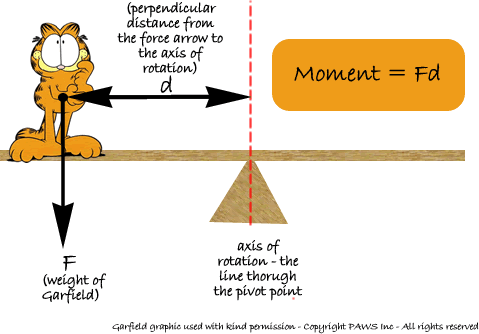





Cyberphysics - a web-based teaching aid - for students of physics, their teachers and parents....

