Momentum

Momentum has two parts to it. The velocity 'v' of the object and also the mass 'm' of the object.
Velocity is a vector so momentum is a vector. Velocity is speed in a particular direction. Momentum has direction associated with it too. If two bodies were moving in opposite directions their momentum would have opposite signs, just as their velocities would have opposite signs.
Click here for information of the conservation of momentum.
Application of momentum to everyday situations
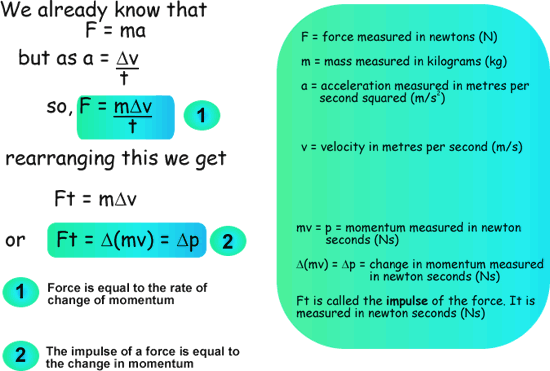
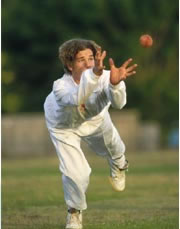
If you are used to catching balls you know that catching a fast light ball can hurt your hands as much as catching a slow heavy one. It can make your hands sting... this is because your hand has to supply the force to change the momentum of the ball to zero (a stopped ball has a momentum of zero as its velocity will be zero and momentum is the product of mass and velocity).
Your sports coach will have taught you to extend the time you spend making the ball stop. By increasing 't' the 'F' is smaller and your hand stings less. So by reaching out for the ball and then pulling it towards you as you catch it you risk hurting yourself less than if you stop it 'dead'.
You need the same impulse to bring the ball to a standstill - you just choose to have a longer 't' and smaller 'F' and that makes the catching experience more comfortable.
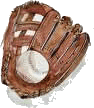
You need to think about that force in terms of pressure too. If you wear a glove to catch a ball the contact area with that ball is greater when you catch it. You therefore experience less pressure from the force when you stop it. This makes damage to your hand less likely - as it is pressure from a force that causes the potential damage.
If you have an accident in a car the car comes to an abrupt halt when you hit another car or wall.
You are travelling at the speed of the car. If you are travelling at about 45 mph (that is about 20 m/s) you have considerable momentum. If you are not secured in the car you will continue to travel forward with that momentum until you hit something that can change that momentum to zero and bring you to a halt. That will usually kill you as you rocket forward through the windscressn or into the back of the neck on the passender in front - perhaps not killing you then (as the other person breaks your fall forward as you break their neck!)..
The force you experience on coming to a standstill yourself when stopped by a seatbelt can kill you or cause significant damage and needs to be made as small as possible.
Your seatbelt provides the force to stop you - so you also have to think about pressure experienced too (width of the belt and the positioning of it are important if it is to save you without cutting into you).
Cars are designed to have a crumple zone that will concertina in on impart extending the time that the car takes to come to a halt and thereby decreasing the force experienced by the car and its occupants.
If a car had no crumple zone the impulse would have a shorter 't' component and a bigger 'F'. The damage to the car might not look as bad but the damage to the occupants would be much more serious! |
 |
Air bags
Changing an object's momentum requires a force acting over a period of time. If momentum changes in a very small time period, as in a car crash, the force is very great. If the momentum can be changed over a longer period of time, even a fraction of a second more, much less force needs to be applied and this resulys in less damage or injury.
In a head-on collision, if a passenger flies into the dashboard of a car, his/her momentum is instantly changed to zero, and serious injury is often the result. If the passenger is restrained by a seatbelt, his/her momentum is reduced more gradually by the constant and smaller force of the belt acting over a longer period of time. Seatbelts can reduce the impact of a passenger to one-fifth of the impact suffered by the body of the car by increasing the time roughly five times.
Air bags are made from a strong coated fabric. They are stored in a module mounted on the steering wheel and dashboard and side panels of the car. The inflation of them is initiated by crash sensors that activate upon impact at speeds of 10-15 miles per hour. They are mounted in several locations on the car body. In a crash the sensor sends an electrical signal to the air bag which then causes the air bag to deploy. It ignites a chemical propellant which produces nitrogen gas, this then inflates the bag itself.. As the driver or passenger' head and chest is thrown into the bag, it slows him/her down more gradually than would be the case with the bag not there. When the air bag is set off and is out to it’s full size, there are vents at the rear which allow air to slowly be removed from it. This is what cushions the head when an air bag works. As the head strikes the bag, it forces air out the vents at the back which allows for the head to sink into the pillow of air and slow the force at which the person comes to a stop.Even though this entire process happens in only 1/25th of a second, the added time is enough to prevent serious injury.
Air bags do not just reduce the impact force by elongating the time factor, they also spread the impact over a larger contact area. By doing this, the force is not all concentrated in one small area of your body and the pressure on your body is reduced. This in turn will cause the seriousness your injuries to be reduced.
They sure go 'bang' when they are set off - might make you think you have been shot!
Tiddles' revenge - see stopping distances video first....
You need to think that if an object that has a lot of momentum comes to a standstill a very big force acts...