 About this site
 |
Interference When two waves meet while they travelling through the same medium we observe a 'merging of the two' within the appearance of the medium. The two waves do not 'bounce off each other' upon meeting (like two balls would) they pass through each other, superpositioning upon each other to encompass the displacement of particles of the medium by both waveforms. This is called wave interference.
There is an addition of amplitudes to give the maximum interference amplitude.
There is a subtraction of amplitudes to give the minimum interference amplitude.
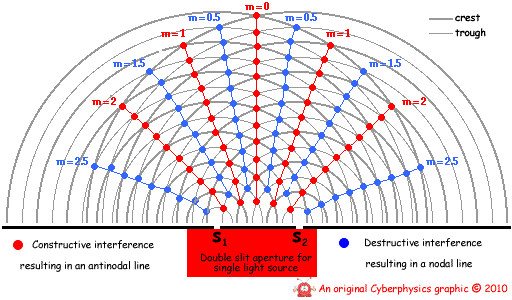
Interference of coherent sourcesWhen two coherent waves (same amplitude and frequency - producing a constant path difference - from a monochromatic source split into two sources) interact with each other, the point in space where two crests meet will suffer positive reinforcement which is called constructive interference as will the points in space where two troughs meet. At these points the amplitude of the wave will be double that of a single wave. The point in space where a crest meets a trough will result in a cancellation of each other which is called destructive interference - the displacement at that point will be zero. In the diagram below all of the zero displacement points are in blue and the maximum displacement points are red. These form antinodal and nodal lines (see stationary waves) If you are looking at interference of visible light you will see bright lines where the antinodal lines are... if these are picked up on a screen you will get a 'fringe pattern'.... see Young's slits.
For constructive interference the path difference between the two waves must be a whole number of wavelengths... or an even number of half wavelengths...2. For destructive interference to occur the path difference between the two waves must be an odd half a wavlength between them .... Here is a great interactive resource from the University of Colorado....
|
Follow me...
|
 Constructive interference occurs at any point where the two interfering waves have a displacement in the same direction (both 'up' or both 'down').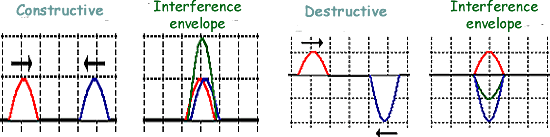

 /2; 4
/2; 4





Cyberphysics - a web-based teaching aid - for students of physics, their teachers and parents....

