Classroom Assistants Classroom Assistant Home How Science Works National Curriculum Pastoral Duties Pupil Misconceptions Risk Assessment Safety - General Teaching Resources Twitter to be informed about updates Whole School YouTube Vid-Clips Students Student Home How Science Works National Curriculum Pupil Misconceptions Risks during practical lessons Safety - General Twitter to be informed about updates YouTube Vid-Clips Student Teachers Student Teacher Home How Science Works National Curriculum Pastoral Duties Pupil Misconceptions Risk Assessment Safety - General Teaching Resources Twitter to be informed about updates Whole School YouTube Vid-Clips Teachers Teacher Home Crosswords General topics Interactive Spreadsheets PowerPoint Presentations Psychology and teaching and learning Revision Flashcards Student Teacher - Index Twitter to be informed about updates Wide Reading - Science in the news YouTube Vid-Clips UK Key Stages KS3 (Y7-Y9) KS4 (GCSE) KS5 ('A' Level) Practice Questions KS3 Questions GCSE Questions 'A' Level Questions Exam Skills Examinations Skills INDEX Accuracy and Precision Calculations - Setting them out English Langusge Sills in Science Equations Equipment - Correct Use Of Errors in a Practical Experiment Examiner Speak Graph Plotting Learning Styles Mathematical Skills Memory Skills Practical Investigations Results Tables Sankey Diagrams Scientist You Should Know About Significant Figures Units - help with learning them Units - Rules Units - S.I. Prefixes Units - Symbols
Topic Menu Atmosphere Earth's Atmosphere Atmospheric Pressure Pressure in the Oceans Atomic Accelerators Atom: Simple Structure Atomic nucleus Atomic Spectra Mass Difference Nuclear Binding Energy Particle Accelerators Photons Photoelectric Effect Radioactivity Rutherford's Model of the Atom Photoelectric Effect Wave-particle duality Electricity Electricity Menu Energy Acid Rain Electromagnetic Energy Future Energy Sources Global Warming Human Energy Intake Ozone Depletion Payback Time Power Stations Sankey Diagrams Sources of Energy Types of Energy Forces Center of Gravity (Mass) Circular Motion Density Dynamics Graphs: Velocity/Time and Displacement/Time Graphs Forces Floating and sinking Friction Gravity Hooke's Law Machines Mass Moments Momentum Newton's Laws of Motion Power Pressure Projectiles Stability Stopping Distances Terminal Velocity Vectors and Scalars Weight Work done by a force Young's Modulus Y11 - Discussion topics - Driving Geophysics Earth's Atmosphere Acid Rain Atmospheric Pressure Plate Techtonics Ozone Layer Depletion Pressure in the Oceans Richter Scale Seafloor Spreading Seismic Waves Structure of the Earth Tides Wegener Calorimetry Cavity Wall Insulation Conduction Convection Double Glazing Expansion Heat Latent Heat Experiment Specific Heat Capacity Pressure Cooker Cooking Radiation Temperature Scales - Dalek Problem Thermometers U-Values Light INDEX Camera Colour Diffraction Dispersion Drawing optical diagrams Electromagnetic Spectrum Eye Fibre Optics Interference L.A.S.E.R.s Lenses Mirror - concave Mirror - convex Mirror - plane Prisms - to divert light Prisms - to disperse light Polarization Refraction Reflection Shadows Straight path for light Total internal reflection Magnetism Magnetism - basics Electromagnetism Electromagnetism Experiment The Earth's magnetic field Levitation Electromagnetic Induction Transformers Magnetic Flux - Higher Level Motor Effect Motor Effect - Higher Level Matter Atom - simple structure Density Kinetic Theory of Gases - Higher level Boyle's Law Charles' Law Ideal Gas Mass Metals - structure and properties Particle Theory Semiconductors Wave Particle Duality Medical Physics Action Potential/option> CT Scanner Ear - Structure Ear - loudness perception Ear - dB and dBA scales Ear - acoustic attenuation L.A.S.E.R.s/option> MRI Nuclear Medicine Applications Particle Accelerator Appications - Cyclotron Optics: Eye and sight correction Optics: Lenses Optics: Ray diagrams Optical Fibres Particle Accelerator Appications - LINAC Ultrasound - basics Ultrasound - higher Level Video Link X-Rays Nuclear Atom: Simple Structure Atomic nucleus Atomic Spectra Mass Difference Nuclear Binding EnergyNuclear Power Particle Accelerators Photons Photoelectric Effect Radioactivity Rutherford's Model of the Atom Photoelectric Effect Wave-particle duality Particles Atom - simple structure Density Kinetic Theory of Gases - Higher level Boyle's Law Charles' Law Ideal Gas Mass Metals - structure and properties Particle PhysicsParticle Theory Semiconductors Wave Particle Duality Radioactivity Radioactivity INDEX - Basic Level Topics Radioactivity INDEX - Higher Level Radioactivity - Glossary of terms Radioactivity - discussion on nuclear fallout Ear - Structure Ear - loudness perception Ear - dB and dBA scales Ear - acoustic attenuation Sound Sound Ultrasound - basics Ultrasound - higher Level Space Big Bang Theory Black Holes Comets and Asteroids Constellations Cosmic Rays Earth: Day, Year & Seasons Eclipses Extraterrestrial Life Light Year Phases of the Moon Red Shift Satellites Solar System Stars Telescopes Universe GAME LINK - Launch a spaceship Temperature Cavity Wall Insulation Conduction Convection Double Glazing Expansion Heat Latent Heat Experiment Specific Heat Capacity Pressure Cooker Cooking Radiation Temperature Scales - Dalek Problem Thermometers U-Values Units Units - learning aids Units - rules Units - symbols Units - S.I. Prefixes Waves Analogue and Digital Coherence Damping of vibrations Diffraction Electromagnetic Waves Interference Oscilloscopes Polarisation Reflection Refraction Resonance SHM - Simple Harmonic Motion Sound Standing Waves Superposition Waves - basic
Colour addition
Colour addition game
Colour shadows
Colour subtraction
Dispersion through a prism
Filters
Pigments
Care with video 2 - red and blue light travel at the same speed - Bill confuses frequency with speed - I would expect you NOT to do that!
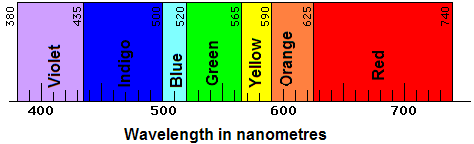
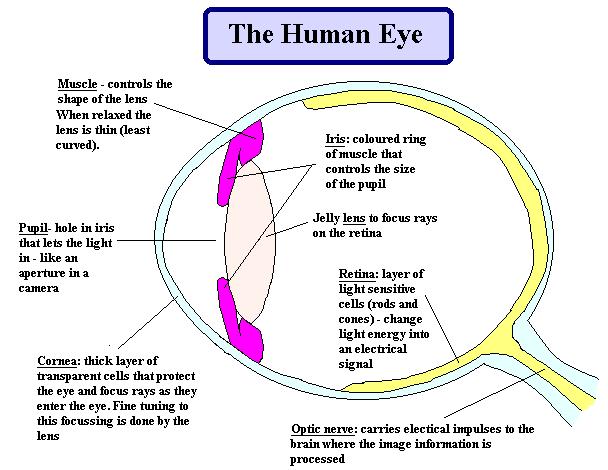
Visible light is made up of photons of electromagnetic energy. Photons of different energy ranges stimulate the cells on the retina in different ways and our brains interpret this by calling that band of energies a 'colour'. The part of the electromagnetic spectrum that has wavelengths between 380nm and 740nm can be detected by the human eye and is therefore called 'visible'. Each band of wavelengths of light stimulate the cones in a different way and we say that there are seven distinct colours in the visible spectrum.
(Note that the 'blue' in this 'rainbow spectrum' is a light blue (it's nearer to 'cyan' than 'blue') and the indigo is nearer to the colour we class as 'blue' in colour addition - a deep royal blue colour - the differences come from the first naming of the colours in the rainbow as ROYGBIV).
Click here for an interactive Java application
Click here for an interactive page that allows you to look at this in more detail - remember each light source has its own distribution of colours.
Single cone-type stimulation is acheived by three 'pure' colours red, blue and green. These are called the PRIMARY COLOURS.
All other colours are seen as the result of two or three of the cone types being stimulated.
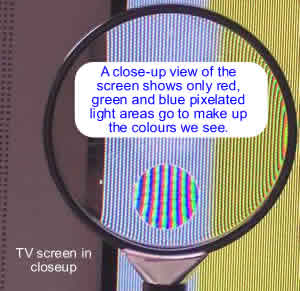
It is therefore possible to simulate ANY colour on a TV screen by varying the intensity of one of these colours on the screen and therefore the amount of stimulation of the cones in our eyes. That is why your colour TV screen only needs to give out three colours.
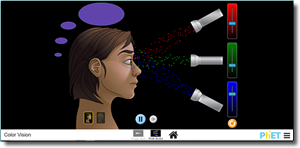
Click here to go to a Java applet that allows you to vary the intensity of the three colours individually and to make up any colour you wish!
Or click on the hex number below and select any colour from the palate to find its hex address!
Colour Addition
Coloured light sources overlapping stimulate cones of both of the colours that overlap - that is why we then see the secondary colours of light at the overlap - two sets are stimulated - secondary. Where there is no overlap we see a primary colour - one set of cones stimulated.
Filters only allow certain wavelengths of light through them, they absorb the others.
So if we pass white light through a yellow and then a cyan filter what colour will we see passing through the combination of filters?
So if we pass white light through a magenta and then a green filter what colour will we see passing through the combination of filters?
Click here for filters used with prisms
Colour Subtraction
When light shines onto an object some of it is absorbed and some of it is scattered back into the eye of the observer.
White objects send all of the colours of the spectrum back into your eye - all three cones in your eye are stimulated equally so the object is perceived as white.
Red objects only send red light into your eye. Therefore only the red cones are stimulated and you say the object 'is red'. The red object absorbs all of the other colours.
Yellow objects scatter both red and green light. Therefore they stimulate the red and green cones of the eye and the brain recognizes the object as being yellow. The blue light in absorbed by the yellow object.
Using this information we can work out what objects look like under different lighting.
The primary coloured objects can only scatter their own colour of light. If it is not there to be scattered they are seen as black. So if the light shining onto them does contain that colour they will be seen as it if it does not contain it they appear black. Therefore red materials always look red or black (no other colour!). If illuminated by cyan light red will look black.
The secondary coloured objects can scatter any combination of the two colours that make them up - therefore under some light they look as if they are of a primary colour. Only when illuminated by light of the colour they totally absorb do they look black. So, cyan objects look black when seen red light.
Pigments appear the colors they are because they selectively reflect and absorb certain wavelengths of light. White light stimulates each of the three colour cones on the retina. When this light encounters a pigment, some wavelengths are absorbed by the chemical bonds and substituents of the pigment, and others are reflected or scattered into our eyes. This creates the appearance of a colour for the pigment.
Blue paint pigment (usually nearer to cyan than the deep pure blue) reflects light that stimulates the blue and green cones and absorbs most of the light that would stimulate the red.
Yellow paint pigment reflects light that stimulates the red and green cones and absorbs most of the light that would stimulate the blue.
The eye therefore gets a double dose of stimulation for the green cones and only a single dose for the other two. The brain therefore registers the mixture of pigments as green.
When you use a colour computer printer the ink colours are yellow, cyan and magenta (and black). If you print a green object the tiny dots on the page will be of cyan and yellow. Both of these dots viewed in white light stimulate the green cones in your eyes but only the magenta ones stimulate the red and only the cyan ones stimulate the blue. You therefore get double stimulation of the green cones and see the object as green on the page of print. Look at the red object - do you understand why the dots are magenta and yellow?
See here for how cameras work
See here for more detail on how our eyes allow us to see different colours (Advanced level work).