L.A.S.E.R.s
L.A.S.E.R. Light
 A laser controls the way that excited atoms release photons. "Laser" is an acronym for light amplification by stimulated emission of radiation, which describes how a laser works.
It is necessary to have a large collection of atoms in the excited state for the laser to work efficiently. In a laser, the lasing medium is “pumped” to get the atoms into an excited state. Intense flashes of light or electrical discharges ‘pump’ the lasing medium and create a large collection of excited-state atoms.
The atoms are usually excited to a level that is two or three levels above the ground state. This increases the degree of population inversion. The population inversion is the number of atoms in the excited state versus the number in ground state.
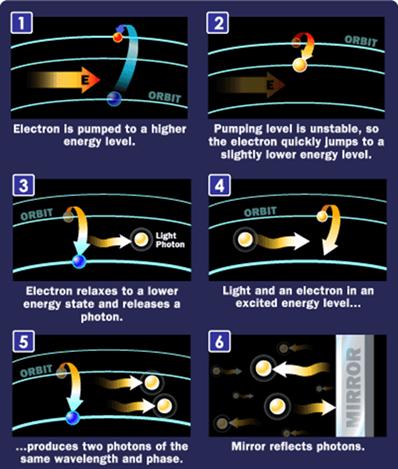
Once the lasing medium is ‘pumped’, it has a lot of atoms with some of their electrons promoted to excited levels. When the electrons ‘relax’ and return to their ground state they themselves of the excess energy. This emitted energy comes in the form of photons of electromagnetic radiation of very specific wavelengths. ( E=hf)
E=hf)
The light released is:
 monochromatic - it contains only one wavelength of light (one colour). The wavelength of light is determined by the amount of energy released when the electron drops to a lower orbit. (E=hf)
coherent. It is “organized” -- each photon moves in step with the others. This means that all of the photons have wave fronts that launch in unison.
very directional. A laser light has a very tight beam and the energy is very concentrated. A torch beam releases light in many directions in comparison, and the light is very weak and diffuse.
Stimulated emission
To make the emitted light have these three properties we need stimulated emission. In ordinary light all of the atoms release their photons randomly. In stimulated emission, photon emission is organized.
The photon that any atom releases has a certain wavelength that is dependent on the energy difference between the excited state and the energy level the electron goes down to. If this photon (possessing a certain energy and phase) should interact with another atom’s electron in the same excited state, stimulated emission can occur.
The first photon can stimulate (or induce) atomic emission so that the photon that has been induced (the one from the second atom) vibrates with the same frequency and direction as the incoming photon.
Mirrors
An important part of a laser is a pair of mirrors, one at each end of the lasing medium. Photons, with a very specific wavelength and phase, reflect off the mirrors to travel back and forth through the lasing medium. In the process, they stimulate other electrons to make the downward energy jump and can cause the emission of more photons of the same wavelength and phase. A cascade effect occurs, and soon we have propagated many, many photons of the same wavelength and phase. The mirror at one end of the laser is "half-silvered," meaning it reflects some light and lets some light through. The light that makes it through is the laser light.
(see ‘How stuff works’ for details of the different types of laser and their uses – not needed for the A2 level medical paper but very interesting!)
Laser Classifications
Lasers are classified into four broad areas categorised acording to their potential for causing biological damage.
|
Class I |
- These lasers cannot emit laser radiation at known hazard levels. |
|
Class I - A |
- This is a special designation that applies only to lasers that are "not intended for viewing," such as a supermarket laser scanner. The upper power limit of Class I.A. is 4.0 mW. |
|
Class II |
- These are low-power visible lasers that emit above Class I levels but at a radiant power not above 1 mW. The concept is that the human aversion reaction to bright light will protect a person. |
|
Class IIIA |
- These are intermediate-power lasers (cw: 1-5 mW), which are hazardous only for intrabeam viewing. Most pen-like pointing lasers are in this class. |
|
Class IIIB |
- These are moderate-power lasers. |
|
Class IV |
- These are high-power lasers (cw: 500 mW, pulsed: 10 J/cm2 or the diffuse reflection limit), which are hazardous to view under any condition (directly or diffusely scattered), and are a potential fire hazard and a skin hazard.
Significant controls are required of Class IV laser facilities. |
 for medical application of the L.A.S.E.R.
 About this site