<BGSOUND src="http://www.cyberphysics.co.uk/file.wav"> Cyberphysics head


Topic Menu


The Pendulum

A pendulum is a point mass - sometimes called a 'bob' - connected to a string, rod or rope, that experiences simple harmonic motion as it swings back and forth. The mathematical treatment assumes the mass is a 'point' so that it is not experiencing air resistance, it also assumes that it swings without friction at the pivot point and that the string is inextensible.

The equilibrium position of the pendulum is the position when the mass is hanging directly downward.

Click here to go to an interactive activity 1

Click here to go to interactive activity 2

Consider a point pendulum bob connected to a massless rope or rod that is held at an angle q from the horizontal. If you release the mass, then the system will swing to position and back again.

Historic Setting

It is recorded that a chance observation of a swinging church lamp led Galileo to find that a pendulum made every swing in the same time, independent of the size of the arc. He used this discovery in measuring time in his astronomical studies. His experiments showed that the longer the pendulum, the longer is the time of its swing.

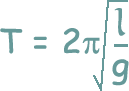
Christiaan Huygens determined the mathematical relationship between the length of the pendulum and the period of vibration when the arc of swing is small. He arrived at the formula:

where

  • T is the period, or time for one complete swing,
  • l is the length - the distance from the point of suspension to the center of gravity of the bob. Care has to be taken that the point of suspension is a point - this can be achieved by clamping the string frimly between two pieces of card.
  • g is the acceleration of gravity.

In 1673, Huygens devised a practicable means of making a pendulum control the speed with which a clock mechanism runs. This led not only in the development of many types of clock, but also in the application of pendulum control to other mechanisms.

Problems and how they were overcome

Metal pendulums expand when heated (longer - therefore period increases!); to counteract the effect of temperature changes, compensation pendulums have been devised, many of them operating by the opposite expansion of different metals in compound rods.

Forces acting on the bob, such as air resistance and friction at the pivot point, affect its swing - great care is taken to minimise friction or movement at the pivot point and a pendulum in a vaccuum will not suffer air resistance (but most pendulum clocks do not need such a great expense!)

Forces acting on the pendulum

When you release the pendulum bob it will accelerate toward the equilibrium position. As it passes through the equilibrium position, it will slow down until it reaches a position -Q, and then accelerate back. At any given moment, the velocity of the pendulum bob will be perpendicular to the rope. The pendulum’s path follows an arc of a circle, where the rope is a radius of the circle and the bob’s velocity is a line tangent to the circle.

To calculate the forces acting on the pendulum at any given point in its trajectory it will be most convenient to choose a y-axis that runs parallel to the rope. The x-axis then runs parallel to the instantaneous velocity of the bob so that, at any given moment, the bob is moving along the x-axis.

Two forces act on the bob:

  • the force of gravity, F = mg, pulling the bob straight downward and
  • the tension of the rope FT pulling the bob upward along the y-axis.

The gravitational force can be broken down into an x-component, mg sin, and a y-component, mg cos.

The y component balances out the force of tension—the pendulum bob doesn’t accelerate along the y-axis—so the tension in the rope must also be mg cosQ.

Therefore, the tension force is maximum for the equilibrium position and decreases with Q.

The restoring force is mg sinQ , so the restoring force is greatest at the endpoints of the oscillation, and is zero when the pendulum passes through its equilibrium position.

N.B. The restoring force for the pendulum, mg sin, is not directly proportional to the displacement of the pendulum bob which makes calculating the various properties of the pendulum very difficult. Pendula, however, usually only oscillate at small angles, where sinQ=Q . In such cases, we can derive straightforward formulae, which are only approximations but work well enough in practice.

Energy

The mechanical energy of the ideal pendulum is a conserved. The potential energy of the pendulum, mgh, increases with the height of the bob, therefore the potential energy is minimized at the equilibrium point and is maximized at the extreme positions. Conversely, the kinetic energy and velocity of the pendulum are maximized at the equilibrium point and minimized at the extremes..

Java Applet Link


Cyberphysics.co.uk is written and maintained by a teacher who has more than 20 years experience of teaching in a British selective girls' Grammar School