 Waves
Waves
You need to KNOW:
 that a progressive wave transports energy from one place to another
that mechanical
waves use particles to transfer energy (neighbouring particles
bump into each other and set their neighbours moving). Eg. sound waves
use air particles so it cannot travel through a vacuum (a vacuum is
empty space with no particles in it at all!). Sound travels faster
through solids than liquids than gases because the particles are more
closely packed.
that electromagnetic waves don't use particles (in fact particles
interrupt their progress through a material) and can therefore travel
through a vacuum. e.g. light
Physical Quantities and their units
distance, displacement, wavelength,
amplitude - all measured in metres (m)
frequency measured in hertz
(Hz)
time, period - measured in
seconds (s)
speed - measured in metres
per second (m/s)
Equations
v
= s/t
speed = distance/time
v = fλ
wavespeed = frequency
x wavelength
NB - be careful
with the case of the letters!
Definitions
The vibrations in a longitudinal
wave are parallel to the direction in which the energy is
travelling. Eg. sound.

The vibrations
in a transverse wave are perpendicular (at right angles)
to the direction in which the energy is travelling. Eg. light.

Click here for an interactive program from Colorado University
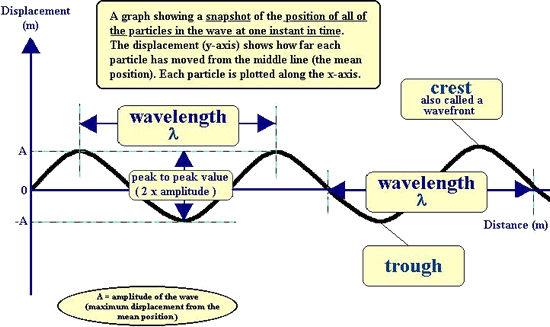
Wavelength ( -
lamda a Greek letter 'l') is the shortest distance between two particles
that are oscillating in phase. (Distance between two crests on a displacement/distance
graph). It is measured in metres (m)
-
lamda a Greek letter 'l') is the shortest distance between two particles
that are oscillating in phase. (Distance between two crests on a displacement/distance
graph). It is measured in metres (m)
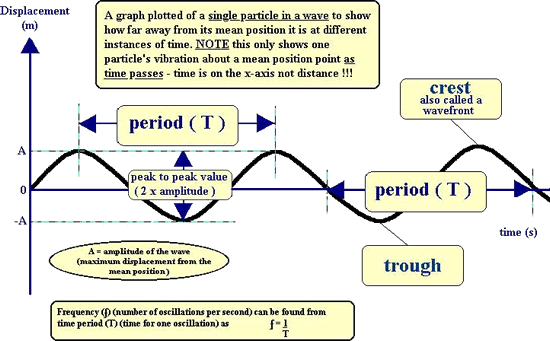
Period (T)is the
time taken for one complete oscillation of a particle in the wave. Distance between two crests on a displacement/time graph. It is
measured in seconds (s).
Amplitude (A) is
the maximum displacement from the mean position.
To the top of a crest or bottom of a trough from the middle line
in either graph).
Frequency (f) is the number of oscillations per second.
It cannot be read
directly off a graph. You need to find (T) from the displacement/time
graph and then find its reciprocal (f =1/T)
Phase difference (A Level topic) - see here
Intensity of a progressive wave (A Level topic) - see here
See the diagrams below
Analogue signals contain all the information as a continuously varying wave
Digital signals are a series of pulses - either high or low - on or off - sometimes
expressed as binary code 1s and 0s.
See Analogue vs. Digital notes
You
need to UNDERSTAND that:-
An oscilloscope is a voltmeter that shows how electrical signals vary
with time on a screen. It can show sound waveforms if a transducer
such as a microphone is connected to it. This changes sound energy
into electrical energy and shows the vibrations on the screen.
In sound : high frequency means high pitch of note (lots of waveforms
on the screen), low frequency (few waveforems) means low pitch
of note (deep note).
In light: high frequency means the blue end of the spectrum, low frequency means red
and of the spectrum.
In sound: big amplitude means loud note, small amplitude means quiet (not low as this can be used for pitch too) note.
In light: big amplitude means bright light, small amplitude means dim light.
to make high pitched sounds you use short, thin strings or short pipes and vice versa.
to make loud notes
you blow hard into wind instruments and pluck hard at string instruments.
that sound travels much
slower than light does.
For the
examination you need to BE ABLE TO:-
Label
wave diagrams :-
Here is a Java simulation to play with...
 |
 Try this useful learning tool to help you learn this topic and/or test your knowledge... Try this useful learning tool to help you learn this topic and/or test your knowledge... |
 |
This image is a rock formation - click on it to find out more... |