
 About this site
 |
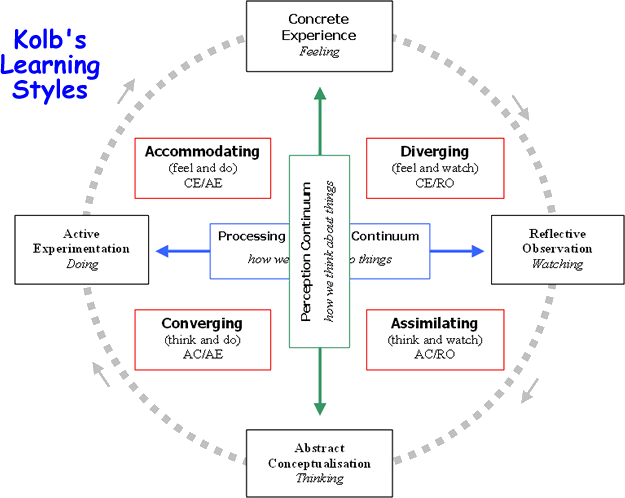
LSI - The Learning Style Inventory  The LSI is designed to determine an individual's learning preference.David Kolb and Ron Fry developed the Learning Style Inventory (LSI) in the 1970s. The model is built upon the idea that learning preferences can be described by observing a learners preferences of :
The result is four types of learners/workers:
An individual may exhibit a strong preference for one of the four styles – Accommodating, Converging, Diverging and Assimilating but most people have elemnts of all four. There is a test, commercially available to find out personal preferences. The Kolb Learning Style Inventory (version 3.1) is available exclusively through Hay Group. (I have not found a reliable on for free online - if you know of one please e-mail me with the link!) We can relate the active experimentation - reflective observation continuum to the extrovert - introvert continuum in MBTI as they both deal with the preference of how the individual likes to interact with the outside world. We can relate the abstract conceptualization - concrete experience to the intuitive - sensing MBTI continuum as they relate to how the individual takes in information about his or her surroundings.
|
Follow me...
|





Cyberphysics - a web-based teaching aid - for students of physics, their teachers and parents....

