 About this site
 |
Intelligence  What is 'intelligence'? The dictionary speaks of 'quickness of understanding or wisdom'.... but to what does that relate? Culturally we have been molded to think of intelligence as relating only to academic subjects - see IQ. You are thought of as intelligent only if you are 'clever at book-learning' but nowadays in the relam of education we put a wider interpretation on the term 'intelligence'.
The invention of intelligence tests caused a lot of problems because they only were able to test one aspect of intelligence. Wechsler, one of the most influential researchers in the area of intelligence defined it as 'the global capacity of a person to act purposefully, to think rationally, and to deal effectively with his/her environment'. Many modern psychology textbooks would accept a working definition of intelligence as 'the general ability to perform cognitive tasks'. Others might favor a more behaviorally-oriented definition such as 'the capacity to learn from experience or the capacity to adapt to one's environment'. Sternberg combined these two viewpoints into the following: 'Intelligence is the cognitive ability of an individual to learn from experience, to reason well, to remember important information, and to cope with the demands of daily living'. The Seven Intelligences
Howard Gardner is a Harvard University professor of education. He separated human ability into groups based on cognitive-contextual intelligence theory. That doesn't limit ''smarts" to the traditional realms of logical reasoning and the ability to manipulate words and numbers. It says we are all endowed with distinct forms of intelligence that are genetically determined but can be enhanced through practice and learning. These abilities are often collectively referred to as the Seven Intelligences - try searching on the web there are lots of references to them and lots of self evaluation tests have been made. In the table below I have listed the seven - they are not in any particular order. Most people have all of these intelligences to some degree but some are specially genetically predisposed towards one or another. At our school the very selection process means that pupils have intelligences 2 and 3 to an enhanced level on entry in year 7.
The encouraging (and cautionary) idea behind the theory of multiple intelligences is the fact that genetic priming for a particular trait does not mean that you will automatically excel in it. It used to be thought with IQ values that you were blessed with a particular intelligence and that was it! You were born to success or failure! This new theory still encompasses the idea that some people have brains that make the development of traditional forms of intelligence easier for them. However, it is superior to IQ measurement in that it also recognises that without work to stimulate that natural ability, and practice to hone skills that are required to develop it, the person will not excel at all.... and we see this happen at WGHS. Some promising girls never achieve their potential because they will not work to develop their skills - they are happy to 'coast' along on their natural ability. They can then get overtaken by their 'less gifted' but more hard-working peers. The Eighth Intelligence: Naturalist Intelligence (“Nature Smart”) In 1999 Gardner added this to his list. It has to do with nature, nurturing and relating information to one’s natural surroundings. Careers which suit those with this intelligence include naturalists, farmers, and gardeners. The human ability to discriminate among living things (plants, animals) as well as sensitivity to other features of the natural world (clouds, rock configurations) was clearly of value in our evolutionary past as hunters, gatherers, and farmers; it continues to be central in such roles as farmer, vet, botanist or chef. It is also speculated that much of our consumer society exploits the naturalist intelligences, which can be mobilized in the discrimination among cars, sneakers, kinds of makeup, and the like. Spiritual Intelligences Gardner considered and rejected adding spiritual intelligences to his lists because of the difficulties in measuring them - and I suspect because of the minefield of cultural and religious dogma that he would have to wade through to make judgements on such a topic. It is however a part of the human makeup that is very important - we just tend to get very upset/violent if people criticise our views on the subject - and some are more strongly naturally disposed towards looking at that aspect of life than others! Existential Intelligence (a concern with 'ultimate issues') This relates to the sensitivity and capacity to tackle deep questions about human existence, such as the meaning of life, why do we die, and how did we get here. It can be termed part of a 'spiritual intelligence'. Moral intelligence - a concern with those rules, behaviours and attitudes that govern the sanctity of life - in particular, the sanctity of human life and, in many cases, the sanctity of any other living creatures and the world they inhabit' . This also can be termed part of a 'spiritual intelligence'. What can you do to develop your intelligences? First of all you must recognise the degree to which you have each one. Perhaps there is one that is 'really you'... perhaps you have all of them to a small/moderate degree. You must then realize that you need to work to improve each skill... and steadily continue to do that. Try using the inventory on this link - it may help you decide the relative strengths of your intelligences. This link may help you understand why you respond better to one teacher's lessons than to another's. It is rather like the Biblical parable of the talents. In that story a master gave each of his servants some money (that aptly happened to be expressed in the currency of the 'talent' - which was about 30 kg of silver). He expected his servants to develop their 'talents' in a manner proportional to their value - the more they were given the more he expected. That should be the way in which you develop your talents. If you are indeed gifted and talented you will already be 'good' at a particular one. The G and T program is to help those who have been lucky enough to have been given an exceptional natural ability in a certain sphere of life really develop it. It is not so that those who are gifted and talented can 'sit back on their laurels' and feel 'clever'. For those who do not exceptionally excel compared with others at school it does not mean that you are not gifted - it just means you are in an environment where everyone is above average so the competition is stronger. You should not be discouraged but should press on to develop your 'talents' at your own rate. Who knows, with work and perseverence you may well overtake some of those that you consider at the moment to be more naturally gifted that you are! |
Follow me...
|
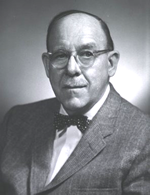 E.
G. Boring (what a name for a lecturer! - see the image of Edwin on the
left), a well-known Harvard psychologist in the 1920's defined intelligence
as 'whatever intelligence tests measure'. That is something to ponder!
E.
G. Boring (what a name for a lecturer! - see the image of Edwin on the
left), a well-known Harvard psychologist in the 1920's defined intelligence
as 'whatever intelligence tests measure'. That is something to ponder!
 The idea that intelligence
is not fixed, but instead is a set of abilities and skills was put forward
in the early 1980s by
The idea that intelligence
is not fixed, but instead is a set of abilities and skills was put forward
in the early 1980s by 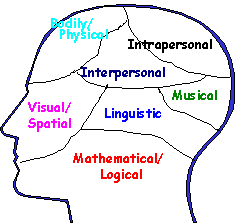





Cyberphysics - a web-based teaching aid - for students of physics, their teachers and parents....

