
 About this site
 |
CFCs - Chlorofluorocarbons
The invention of chlorofluorocarbons (CFCs) in the late 1920s and early 1930s stemmed from the call for safer alternatives to the sulphur dioxide and ammonia refrigerants used at the time. They are non-toxic, non-flammable, and non-reactive with other chemical compounds. This made them to be considered as very safe and ideal for many applications -- such as coolants for commercial and home refrigeration units, aerosol propellants, electronic cleaning solvents, and blowing agents. They were very popular and widely used. In 1973 chlorine was discovered to be a catalytic agent in ozone destructionand it was realizes that CFCs were potentially damaging to the ozone layer. However, conclusive evidence of stratospheric ozone loss was not discovered until 1984. the announcement of polar ozone depletion over Antarctica in March 1985 prompted scientific initiatives to discover the Ozone Depletion Processes, along with calls to freeze or diminish production of chlorinated fluorocarbons. In 1996 CFC production and use was banned. Nowadays fridges and aerosols are marked 'Ozone- friendly' or 'CFC-free' to show that they are no longer used, but the CFCs that were already in the upper atmosphere still carried on depleting ozone for twenty years after the ban was inplace. In 2018 satellite images showed that the hole had begun to close and it is hoped that the damage done to the ozone layer will be completely healed by 2060. |
Follow me...
|
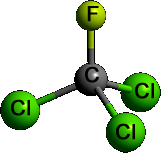 Chlorofluorocarbons (CFCs), along with other chlorine and bromine containing
compounds, are thought to be one of the major group of chemicals that
are causing the depletion of ozone layer.
Chlorofluorocarbons (CFCs), along with other chlorine and bromine containing
compounds, are thought to be one of the major group of chemicals that
are causing the depletion of ozone layer. 




Cyberphysics - a web-based teaching aid - for students of physics, their teachers and parents....

