
 About this site
 |
Potential Difference Potential difference measures the work done per unit chargeThe potential difference (voltage) between two points in an electric circuit is the work done (energy transferred) per coulomb of charge that passes between the points. V = W/Q
W = VQA volt is a 'joule per coulomb' OR a coulomb is a 'joule per volt'
What matters most to an electron?If you were an electron you would have 'charge' as well as 'mass'. The force exerted on your mass by gravity would be negligible compared to the electrostatic force that you would experience because you were charged. You would therefore not be very bothered by the 'ups and downs' in the physical dimension around you - hills and dales, slopes and steps - because the force of gravity does not have a very big effect on you.... but the proximity of any charged object would have a big effect on you - negative charge would repel you strongly and positive charge would attract you.
Don't worry if it looks hard, it is hard maths (not needed until A level)... just look at the answer! Scientific Model
A Scientific Model for Electric Potential
The voltmeterThis is an instrument for measuring potential difference. It measures the difference in electrical height between to levels of electric potential. Each of these are in volts, so it measures potential difference in volts.
Try these questions:
Click here for the answers
|
Follow me...
|


 a type of electrical slope)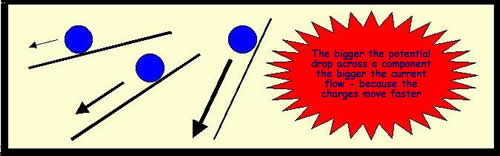
 - the bigger the
potential difference the 'steeper this slope' and therefore the bigger
the force or push they receive.
- the bigger the
potential difference the 'steeper this slope' and therefore the bigger
the force or push they receive. 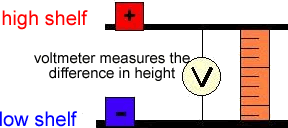





Cyberphysics - a web-based teaching aid - for students of physics, their teachers and parents....

