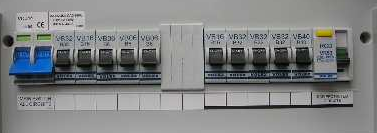
In most homes today you will not find a 'fuse box'. When you have a modern wiring system iinstalled you will have a circuit breaker box installed. Instead of 'changing the fuse' when the lights go out you have to reset the switch for the circuit instead.
Circuit-breakers offer the following advantages compared to fuses.
they respond more rapidly to current surges than fuses do.
they are more reliable.
they are more sensitive.
Unlike fuses which only operate once and need to be replaced a circuit-breaker can be reset at the flick of a switch.
Miniature Circuit Breaker
These circuit breakers allow examiners to link questions to other topics you have studied - they are therefore excellent material for examination questions!
Magnetic MCB
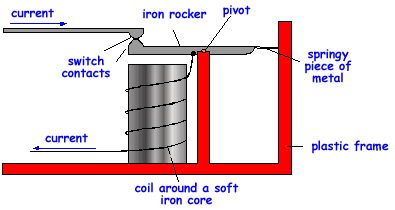
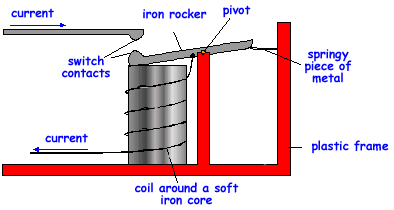
This uses an electromagnet. If the current exceeds the rating of the circuit-breaker the pulling force of the electro-magnet attracts an iron latch which breaks the electrical contacts.
Remeber to revise electromagnets - make sure you KNOW why the core should be made of a soft magnetic material!
The 'springy piece of metal' acts as a catch to reset the switch. The force of attraction between the iron rocker and the electromagnet has to be large engough to overcome the spring catch. Once the iron rocker has been moved down on the left hand side of the pivot the side on the right is pushed past the catch.
When this happens the electrical contacts are broken and the electromagnet loses its magnetic field. The catch prevents the rocker from moving back and re-making the circuit before someone manually resets it.
This uses a bi-metallic strip. The bi-metallic strip is made up of two metals bound together. When heated or cooled the one metal expands (or contracts) more than the other - therefore the strip 'bends'. An increase in current causes an increase in the temperature of the bi-metallic strip. This causes it to bend away from an electrical contact if the current is too large. As soon as the current stops flowing it cools rapidly and is then ready to be reset.
The above vid-clip shows a bimetallics strip operating as a heat sensitive switch - same principle - just used in reverse!

 About this site


 In most homes today you will not find a 'fuse box'. When you have a modern wiring system iinstalled you will have a circuit breaker box installed. Instead of 'changing the fuse' when the lights go out you have to reset the switch for the circuit instead.
 they respond more rapidly to current surges than fuses do.