Uses of Static
Electricity
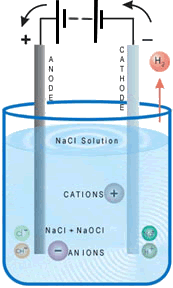
Electrolysis in an electrolyzer :
Flow of seawater or brine between sets of electrodes (anode and cathode) in an electrolyser connected to a source of direct current, the chemical reactions which take place in the electrolyzer between chlorine and caustic produced by electrolysis.
Electrochlorination Reaction :
The direct current, passing through the seawater or brine flowing in the electrochlorinator (electrolyzers), where the sodium chloride is completely dissociated into the ions Na+ and Cl-, causes the following electrochemical and chemical reactions:
Reaction at the Electrochlorinators Anode :
2Cl- ----> Cl2 + 2e- (chlorine generation in the electrolyzer)
Reaction at the Electrochlorinator Cathode :
2H2O + 2e- ----> H2 + 2OH- (hydrogen evolution from electrochlorinator)
Chemical Reaction in Electrolyzer :
Cl2 + 2OH- ----> Cl- + ClO- + H2O
NaCl + H2O = NaOCl + H2 (hypochlorite or hypo generation)

Electrolysis of water - a solution to our fuel needs?
As a fuel, hydrogen has a high calorific value, yielding about 2.8 times as much energy as an equivalent mass of petrol. So instead of a tank holding 70 kg of gasoline motor fuel, a car running on hydrogen combustion could run a similar distance using only 25 kg of hydrogen. Because of its high energy value, liquid hydrogen is the normal fuel for spacecraft. Solar power could be used to provide an electric current and then hydrolysis could split water molecules into hydrogen fuel and oxygen (a very useful gas in itself!).
When burnt as a fuel the hydrogen then just produces water... non polluting!