
 About this site
 |
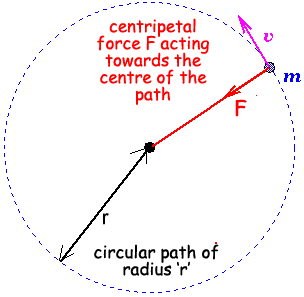
Circular Motion Circular motion is movement along a circular path or a circular orbit.
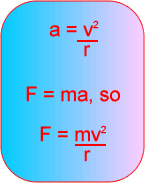
The speed of the object moving in a circleSuppose the object moves with a constant speed of v (see above diagram) The time taken for one cycle of the path is T (the period) The length of the path is 2πr (the circumference of a circle) So v = 2πr/T But ω =2π/T (see the page on angular velocity), so v = ωr The acceleration of the object moving in a circleCircular motion involves the constant changing of velocity (even if the speed is constant the direction is changing all of the time). This means that it involves acceleration of the moving object.
Substititing v = ωr into the equation we get a = ω2r and as F = ma F = mω2r Acceleration is evidence of a force acting.That force is called the centripetal force. It pulls the moving object towards the center of the circular orbit. Without this acceleration, the object would move inertially in a straight line, according to Newton's first law of motion. Circular motion is accelerated motion even if the speed is constant, because the object's velocity vector is constantly changing direction. The centripetal force increases with the size of the mass and the magnitude of the speed of the rotation. It decreases as the radius of the circlular path travelled increases. What provides the centripetal force?
The radius of the turning circleTo make an object take a 'tight cirular path' you have to put in a big force - to change the direction a big mass is travelling in takes a big force, and to make an object that is travelling fast take a circular path requires a big force. Take a look at the following video and think of the force required to pull the hammer's mass into a circle...
This film clip shows how altering the radius of a spinning object affects it speed of rotationThis film clip explains circular motion to A level standard:Car on a banked track
Rotation around a fixed axis of a three-dimensional body involves circular motion too, but at GCSE and A level questions are restricted to simple uniform circular motion in two dimesions. |
Follow me...
|
 With orbiting bodies it is gravity that pulls the satellite into a circular path.





Cyberphysics - a web-based teaching aid - for students of physics, their teachers and parents....

