Classroom Assistants Classroom Assistant Home How Science Works National Curriculum Pastoral Duties Pupil Misconceptions Risk Assessment Safety - General Teaching Resources Twitter to be informed about updates Whole School YouTube Vid-Clips Students Student Home How Science Works National Curriculum Pupil Misconceptions Risks during practical lessons Safety - General Twitter to be informed about updates YouTube Vid-Clips Student Teachers Student Teacher Home How Science Works National Curriculum Pastoral Duties Pupil Misconceptions Risk Assessment Safety - General Teaching Resources Twitter to be informed about updates Whole School YouTube Vid-Clips Teachers Teacher Home Crosswords General topics Interactive Spreadsheets PowerPoint Presentations Psychology and teaching and learning Revision Flashcards Student Teacher - Index Twitter to be informed about updates Wide Reading - Science in the news YouTube Vid-Clips UK Key Stages KS3 (Y7-Y9) KS4 (GCSE) KS5 ('A' Level) Practice Questions KS3 Questions GCSE Questions 'A' Level Questions Exam Skills Examinations Skills INDEX Accuracy and Precision Calculations - Setting them out English Langusge Sills in Science Equations Equipment - Correct Use Of Errors in a Practical Experiment Examiner Speak Graph Plotting Learning Styles Mathematical Skills Memory Skills Practical Investigations Results Tables Sankey Diagrams Scientist You Should Know About Significant Figures Units - help with learning them Units - Rules Units - S.I. Prefixes Units - Symbols
Topic Menu Atmosphere Earth's Atmosphere Atmospheric Pressure Pressure in the Oceans Atomic Accelerators Atom: Simple Structure Atomic nucleus Atomic Spectra Mass Difference Nuclear Binding Energy Particle Accelerators Photons Photoelectric Effect Radioactivity Rutherford's Model of the Atom Photoelectric Effect Wave-particle duality Electricity Electricity Menu Energy Acid Rain Electromagnetic Energy Future Energy Sources Global Warming Human Energy Intake Ozone Depletion Payback Time Power Stations Sankey Diagrams Sources of Energy Types of Energy Forces Center of Gravity (Mass) Circular Motion Density Dynamics Graphs: Velocity/Time and Displacement/Time Graphs Forces Floating and sinking Friction Gravity Hooke's Law Machines Mass Moments Momentum Newton's Laws of Motion Power Pressure Projectiles Stability Stopping Distances Terminal Velocity Vectors and Scalars Weight Work done by a force Young's Modulus Y11 - Discussion topics - Driving Geophysics Earth's Atmosphere Acid Rain Atmospheric Pressure Plate Techtonics Ozone Layer Depletion Pressure in the Oceans Richter Scale Seafloor Spreading Seismic Waves Structure of the Earth Tides Wegener Calorimetry Cavity Wall Insulation Conduction Convection Double Glazing Expansion Heat Latent Heat Experiment Specific Heat Capacity Pressure Cooker Cooking Radiation Temperature Scales - Dalek Problem Thermometers U-Values Light INDEX Camera Colour Diffraction Dispersion Drawing optical diagrams Electromagnetic Spectrum Eye Fibre Optics Interference L.A.S.E.R.s Lenses Mirror - concave Mirror - convex Mirror - plane Prisms - to divert light Prisms - to disperse light Polarization Refraction Reflection Shadows Straight path for light Total internal reflection Magnetism Magnetism - basics Electromagnetism Electromagnetism Experiment The Earth's magnetic field Levitation Electromagnetic Induction Transformers Magnetic Flux - Higher Level Motor Effect Motor Effect - Higher Level Matter Atom - simple structure Density Kinetic Theory of Gases - Higher level Boyle's Law Charles' Law Ideal Gas Mass Metals - structure and properties Particle Theory Semiconductors Wave Particle Duality Medical Physics Action Potential/option> CT Scanner Ear - Structure Ear - loudness perception Ear - dB and dBA scales Ear - acoustic attenuation L.A.S.E.R.s/option> MRI Nuclear Medicine Applications Particle Accelerator Appications - Cyclotron Optics: Eye and sight correction Optics: Lenses Optics: Ray diagrams Optical Fibres Particle Accelerator Appications - LINAC Ultrasound - basics Ultrasound - higher Level Video Link X-Rays Nuclear Atom: Simple Structure Atomic nucleus Atomic Spectra Mass Difference Nuclear Binding EnergyNuclear Power Particle Accelerators Photons Photoelectric Effect Radioactivity Rutherford's Model of the Atom Photoelectric Effect Wave-particle duality Particles Atom - simple structure Density Kinetic Theory of Gases - Higher level Boyle's Law Charles' Law Ideal Gas Mass Metals - structure and properties Particle PhysicsParticle Theory Semiconductors Wave Particle Duality Radioactivity Radioactivity INDEX - Basic Level Topics Radioactivity INDEX - Higher Level Radioactivity - Glossary of terms Radioactivity - discussion on nuclear fallout Ear - Structure Ear - loudness perception Ear - dB and dBA scales Ear - acoustic attenuation Sound Sound Ultrasound - basics Ultrasound - higher Level Space Big Bang Theory Black Holes Comets and Asteroids Constellations Cosmic Rays Earth: Day, Year & Seasons Eclipses Extraterrestrial Life Light Year Phases of the Moon Red Shift Satellites Solar System Stars Telescopes Universe GAME LINK - Launch a spaceship Temperature Cavity Wall Insulation Conduction Convection Double Glazing Expansion Heat Latent Heat Experiment Specific Heat Capacity Pressure Cooker Cooking Radiation Temperature Scales - Dalek Problem Thermometers U-Values Units Units - learning aids Units - rules Units - symbols Units - S.I. Prefixes Waves Analogue and Digital Coherence Damping of vibrations Diffraction Electromagnetic Waves Interference Oscilloscopes Polarisation Reflection Refraction Resonance SHM - Simple Harmonic Motion Sound Standing Waves Superposition Waves - basic
We think of matter as being made up of tiny particles. A particle is a 'tiny part' - it is the smallest part of the whole you can have with it still being the same substance. If you took a lump of something and cut it in half again and agin until you were left with something that you couldn't divide any more - that would be indivisible - and you would have a particle of that substance.
The smallest 'particle' of a compound is a molecule - you'll study those in Chemistry!

The smallest 'particle' of an element is an atom - the details of the interactions and properties of those is again the realm of Chemistry!
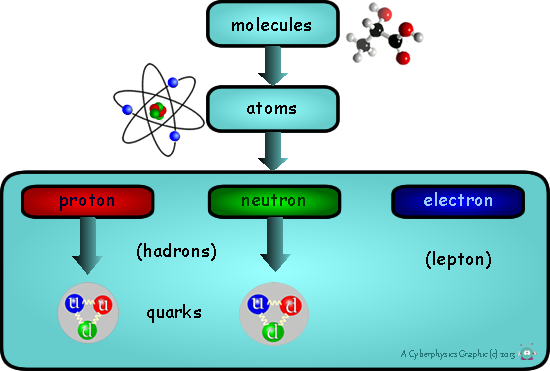
All atoms are made up of protons, neutrons and electrons.
In physics we them break atoms down even further.... but that is the realm of particle physics at A level!
Up to KS4 (Y11) we only look at the atoms and molecules as particles. We totally ignore Chemistry - which looks into the fact that all atoms are not the same but that there is a whole periodic table of them! Instead we look at the 'big picture' of particle behaviour and consider them to all be and behave the same!
Rules for being a 'Particle'
Particles are very small - their size is negligible.
Particles are identical - to simplify our model we will ignore Chemistry - same mass - no awkward shape - no polarity (charge differences within the molecule)
Particles attract one another: the closer they are the stronger the attraction (therefore in solids and liquids attraction is very strong but in gases it is negligible).
Particles are in constant random motion (hence the word 'kinetic' in the name of the theory - random means no preferred direction - as many move in one direction as the opposite - all of the movements are 'balanced' or cancel each other out - no nett movement.
The motion is a combination of these three types:
In a gas the particles are so wide apart that they are totally free from each other's influence! A gas flows easily because the particles can move past one another so easily. They whizz around in straight lines and their translational energy is so great that we can ignore the other two forms most of the time! Their speeds are very high. They bump into each other and the atoms in the container they are in. When they bump into the container sides they create a 'pressure' on the container - the faster they move (i.e. the higher the temperature) the harder they hit the container and the greater the pressure on it - heating a gas sealed in a container is very dangerous as it can explode if the pressure gets too great! No matter how low or high the temperature is a gas always fills the container it is in because the particles whizz round and fill the space - it is the pressure on the container that changes. If the container is flexible (like a balloon) then the increase in pressure as the gas gets hotter (and particles move faster) causes the container to expand until the pressure pushing from the inside of the container (from the gas) is equal to the pressure on the outside (Atmospheric pressure).
Animated gifs: Copyright 2003, Purdue University
Reproduced with kind permission - click on an image to go through to the originator's site!
Internal Energy (A level work)
In the realm of thermodynamics we are interested in the internal workings of mattter. That is the sum total of all of the energies of the particles in it.
The energy that a particle has is down to two factors:
The restraining influence of the other particles works against the liberating kinetic energy. So, if a particle has net 'negative' energy it means that the 'potential' enegy is greater than the kinetic energy and the particle is not 'free' - it will be constrained in a solid or liquid form. If it has no potential energy - only kinetic energy - then it is free! (an ideal gas particle).
Water at 0oC has the same kinetic energy as ice at 0oC but ice has less internal energy because the negative potential energy it has is greater than in water. Energy has to be 'put in' from the outside to melt the ice. When ice melts, the energy that is supplied to it has to break down the rigid structure of the ice crystal and 'free' the water particles.
States of Matter
Evaporation