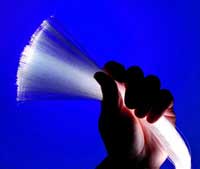
Optical fibres
are just 'reflective tubes'. If you shine light down the tube, and it
keeps going because it bounces from the walls. But if you've ever looked
at optical fibres, you'll notice that they are NOT METALLIZED like a mirror,
they have no silvery coating. They look like transparent fishing line.
Optical fibres are used to carry signals in the form of pulses of light
over distances up to 50km. They do this by Total
Internal Reflection. That's why optical fibers can guide light for
such long distances - because the walls of the fibre don't absorb any
light at all as long as the angle of incidence is greater than the critical angle. Total Internal Reflection causes 100% reflection.
In no other situation in nature does this occur, so it is unique and very
useful as it is 100% efficient at transfering the light energy.
There are two conditions necessary for Total Internal Reflection to occur:
- The refractive
index of the first medium is greater than the refractive index
of the second medium (n1>n2)
- The angle
of incidence must be greater than the critical angle (i>c)
When light hits the boundary between two substances it gets reflected and refracted. Light principally refracts at low angles of incidence, but as the angle of incidence increases the percentage of the light energy that reflects rather than refracts
increases until the internal surface acts as a mirror. This is called TOTAL INTERNAL REFLECTION, because all of the incident light energy
is reflected. The reflection then is even better than at a mirror's surface because 100% of the light energy is reflected by TIR whereas reflection at a mirror surface is never 100%.
Construction
(not required at GCSE)
A fibre optic cable
is made from a glass core (or in cheaper lower grade ones - plastic), that carries the light, surrounded
by a glass cladding of lower refractive index, which reflects escaping light back into the core. Without the cladding
the light would pass between the fibres as they are all made of glass,
would not have a lower refractive index boundary for TIR to occur at
and therefore would allow light transfer. They are about usually about
120 micrometers in diameter.(very thin strands)
Surface scratches
can lead to 'light leakage' in a single fibre. Additional layers
of treated paper, PVC or metal may further protect the outside of the
fibre.
The core has to have a higher
refractive index than the cladding so that TIR is possible. Although the cladding does not carry
light, it is nevertheless an essential part of the fibre. It is not
just a covering.
The overall cable construction is shown in the diagram below
Advantages
over Copper Cable
Fibre optic cables can carry signals with much less energy loss than copper cable as copper wires lose signal energy as heat (P=I2R) due to their resistance.
They are
much lighter than copper cables with the same band width, so much
less space is required in underground cabling ducts and costs
for transportation and handling are therefore less.
They are immune to electromagnetic interference from radio signals, lightning
etc
They can
be routed safely through explosive or flammable atmospheres where
are the risk of sparks from electrical cables would be to great
for them to be used without a lot of precautions taken.
The raw materials
to make them are plentiful (silicon from sand!) whereas copper
supplies are dwindling.
Disadvantages
over Copper Cable
Optical fibres
are still more expensive per metre than copper because they are
manufactured to a high standard and are made to carry multiple
signals.
They cannot
be joined together as easily as copper cable
Areas
of Application
Telecommunications
Sensor
Manufacture
Local Area
Networks
Cable TV
CCTV
Optical
Fibre Sensors
Communications (telephone, cable TV)
Fibre-optic cables use light to transmit information over great distances at high speed. They are used widely in telecommunications because of their many advantages over copper cable.They are smaller, cheaper (overall) because you can snd more information with less 'degradation' or signal loss than other kinds of cables. Today these cables are found in local cable TV and internet connections and most international telephone networks.
The fibres used in long-distance telecommunications are made of very pure glass rather than plastic, because glass does not absorb the enegy of the light signals as much as plastic does. For shorter distances, plastic is often used as it is cheaper.
For very short distances, fibre-optics are not the best choice. Cables such as copper wires and coaxial cable, which transit information using electricity are easier to join together or splice into new circuits. In very short distances, there is very little need for the speed and huge volumes of transmission that fibre optic cables can offer.
A Telecommunications
Link is the simplest of fibre optic systems.
It consists basically of
a transducer (to change the electrical signal into light energy), a transmitter (that generates light pulses to travel along the fibre) , a fibre link and a receiver to detect the light gignals and transfer them into electrical output.
The transmitter will normally
be equipped with a laser diode that usually has an output wavelength
of 1300nm or 1500nm.
The fibre link will be made of single lengths of
optical fibres 2km in length, which are fusion spliced (joined) together.
The link will be able to carry thousands of telephone conversations simultaneously
by means of time division multiplexing. This basically means that the
data in multiple conversations is split up and sent down the cable.
When it reaches the other end of the cable, the individual conversations
are put back together again. This would not be possible with copper cabling.
Microbending
Sensor
A microbending sensor
consists of two plates between which passes an optical fibre. The plates
have parallel grooves on their facing surfaces and the grooves from
the two plates interleave with each other. The fibre passing between
the plates is therefore bent alternatively up and down. When a fibre
is bent sufficiently the light in the core no longer meets the cladding
at an angle equal to or greater than the critical angle. Total Internal
Reflection therefore does not occur. This is called microbending loss,
and the more a plate is bent, the more loss occurs. This has a military
application of submarine detection.
Blood
Components Sensor
If we use the correct
wavelength we can measure the concentrations of specific components
of blood such as total protein, cholesterol, urea and uric acid quickly.
When the concentration is high, the output at the detector is less and
vice versa. The concentrations of those chemicals are important to doctors
in the diagnosis and monitoring of certain disease conditions. Fibre
optic sensors can give results very quickly without having to send samples
away to an analytical lab.
Endoscopes
are used to look inside people - they can also be used for industrial purposes - looking down tiny holes etc.
An endoscope is a thin, flexible telescope. It is about as thick as a little finger. An endoscope can be passed through the mouth, into the oesophagus and down towards the stomach and duodenum. Or, it can be gently inserted into the rectum and through the colon.
For examination purposes you need to know about old fashioned endoscopes:
An endoscope consists two light guides. One is a narrow bunch of fibres - coherently arranged -
with a lens system at each end.This system of fibres carries the image from the inside of the patient.
Light is carried down intoo the patient by another bunch
of optical fibres - these do not need to be coherent as they only are there for illumination. The light from this bundle lights up the inside of the patient and after being scattered by the patient's insides this light returns to the doctor via the coherent bundle.
The image can be seen on the lens - but this is often awkward and so this is displayed as a full colour-moving image
on a television screen - the results can be recorded fo further inspection after the procedure and to be kept as a record for further consultation.
Modern endoscopes are cheaper and thinner because they do not need to have the coherent bunch of fibres. They use a bundle of cheaper non-coherent fibres to carry the light into the body and they then have a tiny camera fitted on the tip of the endoscope. This can wirelessly send images to the doctor's monitor. This has not leaked through to exam boards yet - but might be a useful footnote for you in questions. They often ask the question on endoscopes for you to mention the difference between coherent and non-coherent bundles... so do so!
This allows a surgeon to see inside a patient without cutting them. This is considerably safer than a surgical investigation - no anaesthetic - no incision!
This equipment also makes keyhole surgery possible. Keyhole surgery reduces the risk to the patient by reducing the need for as much anaethetic and reducing the size of incision.