Concave Mirrors: constructing a ray diagram
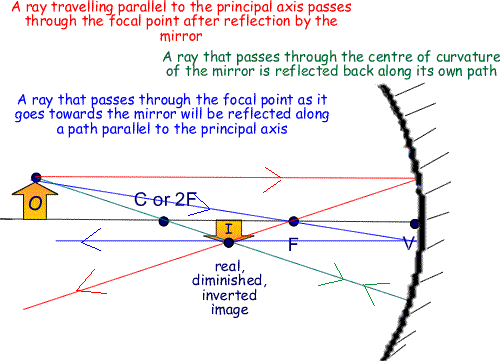
- Draw the principal axis across your page.
- Using a compass draw the curved mirror so that it is bisected at the principlal axis. Ray diagrams are drawn to scale - so whatever value you are given for the focal length of the mirror will be doubled for the radius of the circle that you draw for the mirror.
- Add the chevron shading.
- Label the point that your compass went through C (or 2F) and the point where the line of the principal axis cuts the mirror V.
- Measure CV and put a point F halfway along the principal axis.
- Place your object point (to scale) on your diagram. Add an arrow going from the principal axis to that point (pointing towards it!).
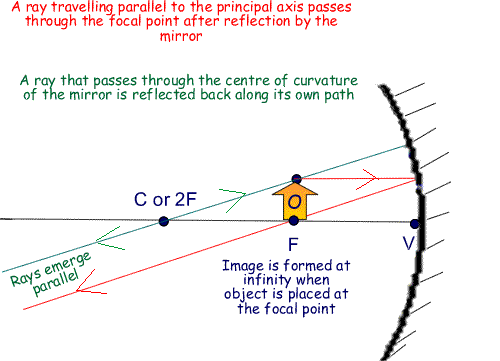
- Take a ray from the object through 2F (or C) to the mirror. Add two arrow heads on it in opposite directions.
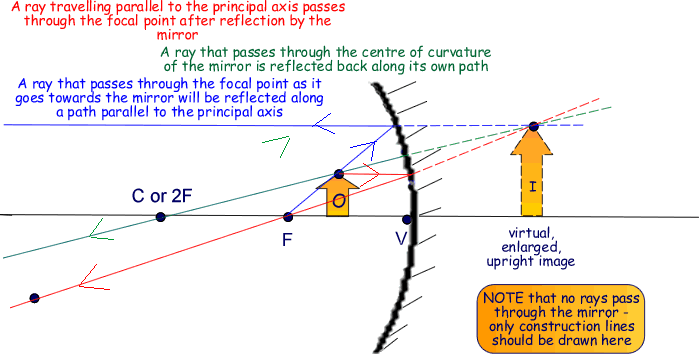
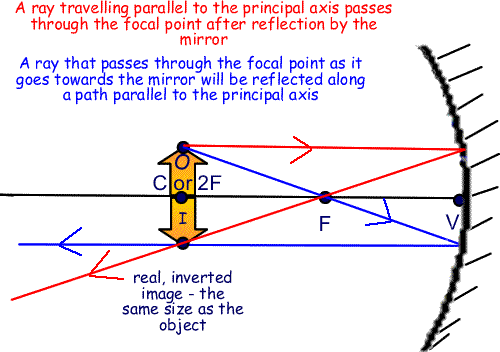
- Take a ray from the object point travelling parallel to the principal axis and mak it hit the mirror. (Add the arrow). Now make it reflect so that it passes through F. (Add the arrow)
- Take a ray from the object and make it pass through F on its way to the mirror. (Add the arrow). Make it reflect from the mirror so that it travels parallel to the principal axis.
If you have drawn your diagram carefully the rays will all cross at one point. That is your image point. Label it and then draw an arrow going from the principal axis to that point.
1. Object beyond C

2. Object between C and F
3. Object between V and F

4. Object At F

5. Object At C
Is the image formed upright or inverted?
Ray diagrams of concave lenses are constructed from the principal axis line - the object is a point (shown by an arrow, the base of which starts at the principal axis) - the image point when found is then also highlighted by an arrow that originates on the principal axis - that shows you which way up the image is.
Is the image formed real or virtual?
If the image is formed at the junction of rays it is real. If it is formed at the junction of construction lines - drawn out from diverging rays - it is virtual and should be drawn as a dashed arrow..
Uses of concave mirrors
Basically, they are used any time you want to make something’s reflection look bigger
In a shaving mirror or makeup mirror your reflection is larger so that you can perform personal grooming to a high standard.
Concave reflectors are used in car headlights. The bulb of the head light is placed at the focal point of the reflector. The reflected light emerges in a parallel beam and gives more concentrated visibility to the driver at night.
Concave mirrors are used in solar powered gadgets. The parallel rays of the sun are reflected to focus at the focal point F. The solar energy concentrated at F is then used (usually the IR is used - heat focus) or converted (for example into electrical energy by a solar cell) by the gadget
Historical Footnote
It has been said that Archimedes used a large array of mirrors to burn Roman ships during an attack on Syracuse . This has never been proved or disproved; however, recently, on a popular Discovery Channel show, MythBusters, a team tried to recreate the famous "Archimedes Death Ray". They were successful at starting a fire on a ship at 75 feet away, however, previous attempts to light the boat on fire using only the bronze mirrors available in Archimedes' time were unsuccessful, and the time taken to ignite the craft would have made its use impractical, resulting in the MythBusters team deciding that the myth was just a myth!
Click here to download a question sheet
Click here for a Java applet on convex and concave lenses and mirrors!