
Refraction
(AS
level students) see Snell's Law and
Composite block
Real
and Apparent Depth
Refraction
of seismic waves
Refracting Telescope
Total
Internal Reflection

When a wave moves
between two different media it changes speed (unless the two media
have identical densities). This is refraction and leads to a change in
the direction the wave travels in (unless it hits at a zero angle of incidence).
The frequency of the
wave does not change - that is down to the frequency at which the source
is vibrating - which is not affected by whatever medium the wave later
travels through! But, because
v =
f 
when the speed changes the wavelength will change too.
If speed increases the wavelength gets longer, and if it decreases the
wavelength gets shorter..... see the illustration below.
Photons of electromagnetic
radiation (of which light is an example) always travel at the speed of
light - 3.0 x 10⁸ m/s - that is why the symbol 'c' was given
to that speed - it is constant! But as it travels though matter it does
so in a series of 'stop and go' movements. It interacts with the particles
in matter - gets absorbed and then re-emitted and that takes time. The
average velocity at which it travels through a medium is therefore always
slower than it would travel through a vacuum.
Light travels faster
through 'rare' optical media - eg. air - because it does not have to 'waste
time' interacting with as many particles in a given space - and fastest
it possibly can in a vacuum because there are no particles for it to interact
with at all.
Light travels slower
through 'dense' optical media such as water or glass because there are
more particles to interact with in a given time.
(BUT sound travels
faster in denser media as that is NOT energy travelling as little photons
but rather vibrational energy of the particles themselves! Therefore the
closer packed they are the easier it is to pass the energy on.... So be
careful... it is not the density difference that makes the refraction
occur but the overall speed change!)
Waves travelling across
the surface of water can also be refracted. The change in the speed of
water waves when they cross the boundary between two different depths
causes a change in their direction (refraction), unless the direction
of travel of the waves is along a normal. Water waves travel faster in
deep water than in shallow.
How to remember this:
Slow in Shallow (therefore the wavelength in shallow water
is Small)
When a wavefront changes
speed it changes direction (unless the angle of incidence is 0o
- then no change in direction occurs - it is undeviated - but the speed
still changes!)
Below is an animation
of waves going from one medium to another and slowing down. (It could
represent light going from air to glass, or sound going from a solid like
rock into air, or water going from a deep to a shallow depth).
The 'lines' represent
the crests of the waves as they travel through the medium and the arrowed
line represents the direction of travel (it is at right angles to the
crests of the waves and is the 'ray' of those waves - it indicates which
direction the wave is travelling in).
Slide
your mouse-pointer over the diagram to see the wavefronts move.
(Warning!
If you are made to feel ill by flashing lights - the diagram animation
may make you feel queasy)

Can you
see how much slower the wavefronts are in the cyan (lower) medium? They
travel more slowly and so the wavelength of the wave is smaller.... and
they change direction because they cannot travel as fast.... but the rate
at which they move is unaltered as their frequency is unchanged.
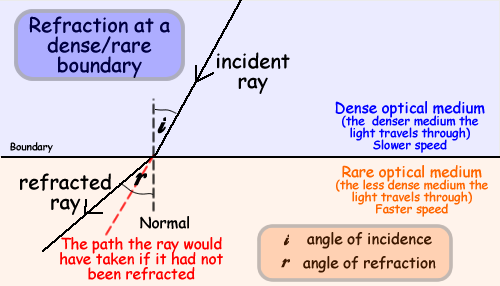
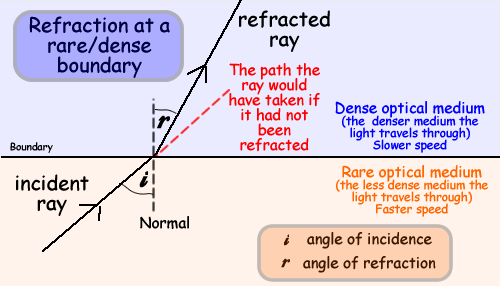
So we can see that
if a ray speeds up it bends away from the normal - i.e. it makes a bigger
angle with the normal than it did before - it swivels away from the normal.

and if a ray slows
down it bends towards the normal - i.e. it makes a smaller angle with
the normal than it did before - it swivels towards the normal.

Real
and Apparent Depth
Refraction
leads to optical illusions. Whe we look at something under water (or glass)
it does not appear to be as deep as it really is.
The brain
interprets the rays as having travelled in a straight line and therefore
forms the image at the point the refracted rays 'appear to come from'
NOT taking into account the fact that they have been bent as they leave
the water.

When
you are dealing with 'sound' waves remember that sound waves travel fastest
in dense media and slower in less dense ones. Therefore for sound waves
refraction towards the normal indicates a speeding up of the wave! - see
seismic
waves
Refraction
is evidence of the wave nature of light - we can only explain refraction
in terms of waves.
Now
revise the topic from flash cards I have written for:
Refraction may be our route to invisibility...
LOJ
October 2002 amended March 2003