<BGSOUND src="http://www.cyberphysics.co.uk/file.wav"> Standing Waves head


Topic Menu


Standing or Stationary Waves


The above vidclip is a demo of the standard classroom 'vibrating sting' - listen carefully to the teacher - she touches on a lot of information in this clip!

Below is a wonderful vidclip of standing waves in water - couldn't do this easiliy in a school lab!

The next vidclip is amazing - surfing on a standing wave...


A standing wave or a stationary wave, is a wave that has parts that remain in a constant position

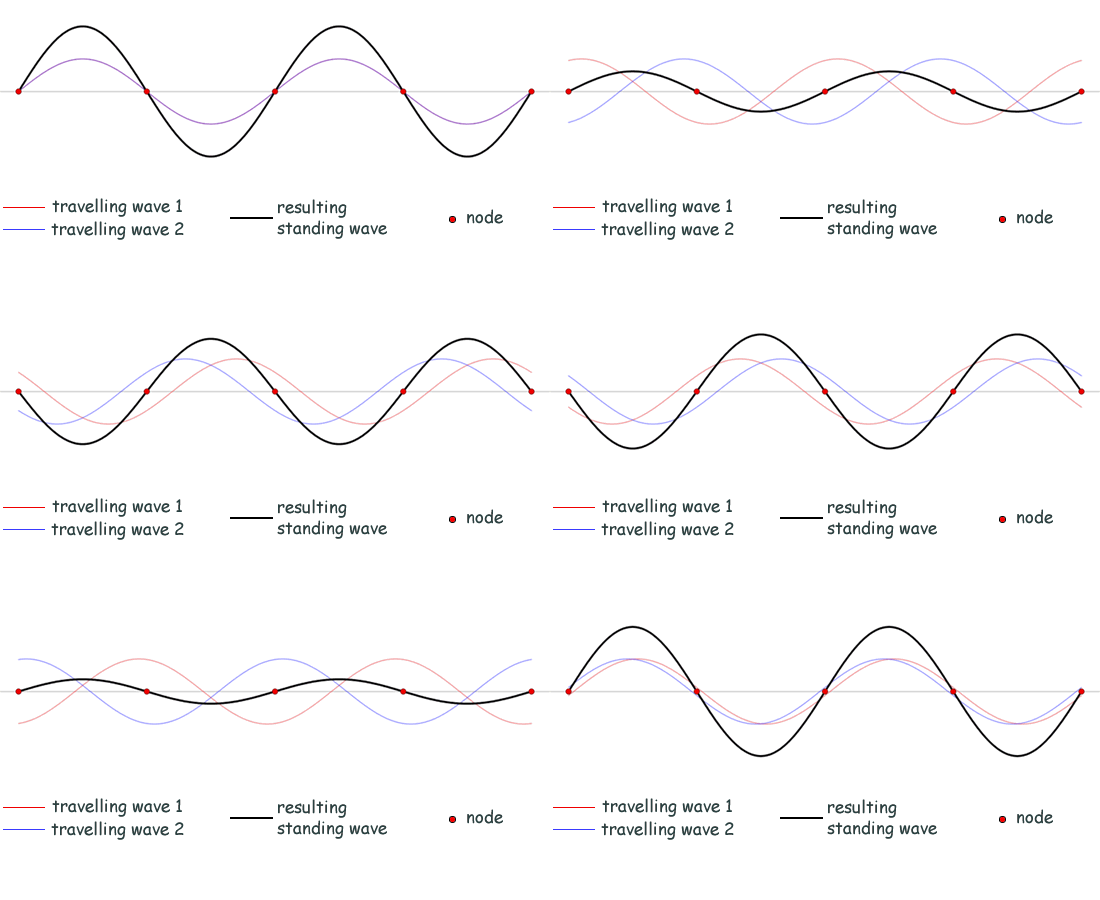
Nodes - points of no displacement - remain in the same position. Particles at those points are not vibrating at all.

Antinodes are points on the waveform where the particles suffer maximum displacement.

Standing waves can occur when the medium is moving in the opposite direction to the wave (as in the surfing vidclip above), or it can arise in a stationary medium as a result of interference between two waves travelling in opposite directions (the usual source for a question at A level).

In the second case, for waves of equal amplitude travelling in opposing directions, there is on average no net propagation of energy. The energy 'stands still' so it is a standing wave - or is stationary - another way of putting it! The best way to get two waves of equal frequency, wavelength and amplitude so that you get completely destructive interference at the nodes is to reflect a wave from a fixed point.

For vibrations in a string (e.g. the plucking of a guitar string) there are two fixed nodes at each end.

Nodes (red dots) are points of no vibration and antinodes are points of maximum vibration. Look at the following animation to see how the standing wave envelope is formed...

Now let us consider the length 'L' and its relationship to the wavelength and frequency:

In fundamental frequency mode we can see that we have half a waveform

L = 0 /2

now as c = f

L = c/(2f0)

and f0= c/(2L)

so the fundamental frequency is half of the ratio of the speed to the length

In a similar way we can examine the harmonic or overtone modes:

  • for the first harmonic L = 1 so f1= c/L = 2 f0 (double the frequency of the fundamental - therefore one octave higher)
  • for the second harmonic L = 2 so f2=3c/2L = 3 f0 (triple the frequency of the fundamental)
  • for the third harmonic L = 23 so f3= 2c/L = 4 f0 (double the frequency of first harmonic - therefore one octave higher than that and two octaves higher than the fundamental)

All of the particles between two nodes vibrate in phase with each other but the amplitude of vibration varies from zero at the node to maximum at the antinode back down to zero at the second node. There are therefore two particles that are in phase and have the same frequency in each 'lobe' of the wave... except for at the antinode where there is just one maximum.

Neighbouring 'lobes' are in antiphase with each other.

Faraday waves (not on the A level syllabus) , also known as Faraday ripples, are nonlinear standing waves that appear on liquids enclosed by a vibrating receptacle. They are named after Michael Faraday, who first described them in an appendix to an article in the Philosophical Transactions of the Royal Society of London in 1831.

If a layer of liquid is placed on top of a vertically oscillating platform, a pattern of standing waves appears which oscillates at half the driving frequency. These waves can take the form of stripes, close-packed hexagons, or even squares or quasiperiodic patterns. Faraday waves are commonly observed as fine stripes on the surface of wine in a wineglass that is ringing like a bell.

This vidclip is really cool - the physics of these waves is outside the scope of this site but wow!


Cyberphysics.co.uk is written and maintained by a teacher who has more than 20 years experience of teaching in a British selective girls' Grammar School