
Q1.
A battery is connected to a 10 resistor as shown. The e.m.f. (electromotive force) of the battery is 12V.
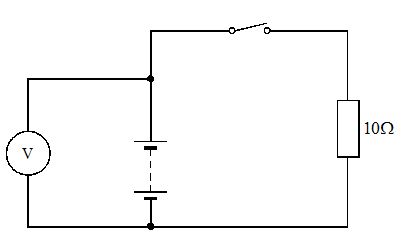
(a) (i) Explain what is meant by the e.m.f. of a battery. The EMF is the energy provided by a battery per unit charge (OR when no current flows it is the potential difference across the battery ) (ii) When the switch is open the voltmeter reads 12.0V and when it is closed it reads 11.5 V. Explain why the readings are different. A potential difference is developed across the internal resistance
(a)
(i) Explain what is meant by the e.m.f. of a battery. The EMF is the energy provided by a battery per unit charge (OR when no current flows it is the potential difference across the battery ) (ii) When the switch is open the voltmeter reads 12.0V and when it is closed it reads 11.5 V. Explain why the readings are different. A potential difference is developed across the internal resistance
(i) Explain what is meant by the e.m.f. of a battery.
(ii) When the switch is open the voltmeter reads 12.0V and when it is closed it reads 11.5 V. Explain why the readings are different.
(3)
(b) Calculate the internal resistance of the battery. I =11.5/10 = 1.15A 'lost volts' = Ir 12 – 11.5 = 1.15 × r r = 0.43 OR EMF/I = R + r 12/1.15 =10 + r 10.43 - 10 = r = 0.43
(b) Calculate the internal resistance of the battery.
(3) (Total 6 mark)