Ensure you understand what 'magnetism' is before you start on electromagnetism... domains, field lines, poles etc
Take a minute to think about that....
Electrons, protons, ions, alpha particles and beta particles are all charged.
When stationary they have no magnetc field around them, but when they move they have! Wow!
It also follows thatall electrical wires have a magnetic field around them (but
only when the current flows).
How to draw a representation of a current carrying wire
The field lines form a concentric circle
pattern around the wire.
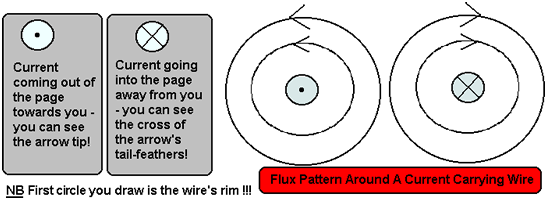
The symbol for the current carrying wire itself is a section through the wire (as shown below). The field lines are then drawn around it.
You are used to the idea that the scientific symbol for a current in a wire is an arrow.
You usually draw a side-on view of a wire - a line, but in this case you are drawing a section through the wire - a circle - and you therefore draw a section through the arrow too!
A current carrying wire has either the arrow tip (current
coming out of the page at you) or the cross of the tail feathers of
the arrow (current going into the page away from you) shown within the circle that represents the section of the wire.
NB Don't treat the circle
that represents the edge of the wire as a field line.... if you put an arrow on it your wire section disappears!!
The Right Hand Grip Rule
The direction of the field lines can be found using the
right hand grip rule.
You must know this at GCSE level (and at A level of course!)
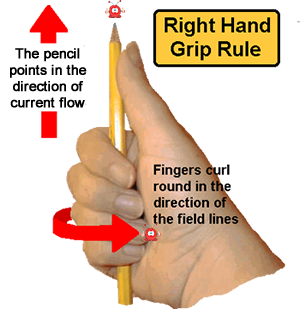
Grip a pencil in your
right hand.
Hold it so that your thumb points in the same direction as the pencil
tip and your fingers curve around it. (see the diagram).
The pencil represents the current
and its tip the direction of the current arrow.
When determining the direction of field lines, place the pencil on
the page (tip into or away from page as required) and then your will fingers
point in the direction of the field lines.
 About this site


 Ensure you understand what 'magnetism' is before you start on electromagnetism... domains, field lines, poles etc
 Take a minute to think about that....